Cyber Monday is expected to cross $15 billion in U.S. online spending for the first time on November 30, 2026. Yet the more important story for ecommerce teams is that the event is becoming less like a single Monday and more like the closing stage of a month-long campaign shaped by AI referrals, creator commerce, and earlier discounts.
Adobe forecasts $15.1 billion in U.S. ecommerce sales on Cyber Monday, up 6.2% from 2025. That would keep it as the largest online shopping day of the season. Black Friday is projected to reach $12.9 billion and grow faster at 9.2%, however, as retailers bring stronger offers forward and shoppers stop treating Monday as the only moment worth waiting for.
Cyber Monday 2026 by the numbers
- November 30: the date of Cyber Monday in 2026.
- $15.1 billion: forecast U.S. online spending for the day, up 6.2% year over year.
- $47.5 billion: expected Cyber Week online spending, up 7.4%.
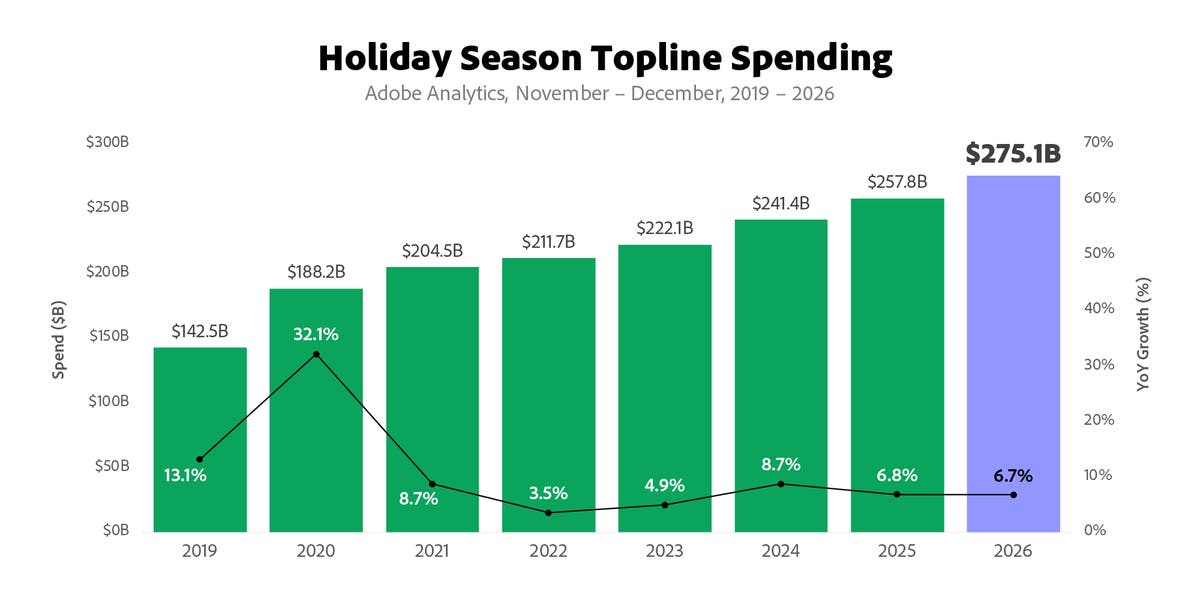
- $275.1 billion: forecast U.S. ecommerce sales for November and December, up 6.7%.
- 88%: forecast growth in traffic from AI-powered services to retail sites on Cyber Monday.
- November 11-30: TikTok Shop’s U.S. Black Friday and Cyber Monday campaign window.
Cyber Monday is still the biggest day, but it no longer owns the whole story
The headline number is undeniably large. Adobe’s forecast would put Cyber Monday nearly $900 million above the $14.25 billion recorded in 2025. Cyber Week, the five days from Thanksgiving through Cyber Monday, is expected to generate $47.5 billion, or 17.3% of all U.S. online holiday spending.
But the growth rates reveal a change underneath the record. Black Friday is forecast to grow three percentage points faster than Cyber Monday. Retailers are starting campaigns earlier, and shoppers can see many of the same offers across the weekend. The old rhythm of browsing in stores on Friday and buying online from a work computer on Monday has largely disappeared.
For merchants, that means Cyber Monday should not be planned as a second launch built from scratch. It is better treated as a new chapter in the same campaign: refresh the creative, give customers a reason to return, and use the weekend’s inventory and conversion data to decide which products deserve the final push.
TikTok Shop starts its Cyber Monday campaign today
TikTok Shop’s U.S. Black Friday and Cyber Monday campaign begins today, November 11, and runs through November 30. That twenty-day window is a useful illustration of what Cyber Monday has become: not a date that marketing begins, but the deadline at the end of a much longer discovery and promotion cycle.
According to TikTok’s 2026 holiday announcement, #holidayshopping content rose 263% in September from the previous month. The company says users made more than 100 billion searches with ecommerce intent on TikTok Shop in the U.S. during 2025, while its product selection has expanded by more than 1,200% since 2024.

The platform has a meaningful base to build on. TikTok Shop says sales exceeded $500 million during the four-day Black Friday and Cyber Monday weekend in 2025. Sellers that hosted livestreams recorded 84% year-over-year sales growth across more than 760,000 live sessions and 1.6 billion views. Those are company-reported figures, but they show why creator-led shopping now belongs in the Cyber Week conversation rather than in a separate social media plan.
The practical implication is not that every store needs a marathon livestream. A product that needs demonstration, sizing advice, comparison, or trust can benefit from live explanation. A familiar replenishment product may be better served by a clear offer and fast checkout. Format should follow the buying question, not the platform trend.
AI shopping traffic is becoming measurable
Adobe expects traffic from AI-powered chat and browser services to U.S. retail websites to rise 130% across the holiday season. The forecast increase is 159% on Thanksgiving, 95% on Black Friday, and 88% on Cyber Monday.
It is important to read that correctly. Adobe is measuring shoppers who click a retail link from an AI service; it is not forecasting that AI will generate 88% more revenue. Referral traffic can grow quickly from a small base, and attribution becomes less tidy when a shopper researches in an assistant, checks creator content, searches the brand, and later buys through email.
Still, this traffic is no longer theoretical. Adobe’s 2025 Cyber Monday recap recorded a 670% increase in AI-referred visits. For 2026, the operational question is whether product pages give an assistant and a human shopper the same reliable facts: current price, variants, availability, delivery timing, returns, specifications, and a clear explanation of what makes the product different.
Retailers should also separate AI referral traffic in analytics where possible. Watch conversion rate, average order value, new-customer share, and returns rather than celebrating visits alone. Adobe says 77% of surveyed consumers who had used AI for shopping felt more confident in the purchase, and 69% said they were less likely to return the item. The actual behavior on an individual store matters more than the survey result.
Cyber Monday demand is moving beyond electronics and gifts
Adobe expects discounts to peak at up to 30% off listed prices in some categories, but it also sees shoppers using the event to stock up on everyday products. During Cyber Week, online sales of personal hygiene products are forecast to rise 150% compared with average September levels, while clothing basics are expected to jump 210%.
This changes the promotion logic for brands that do not sell televisions, toys, or giftable gadgets. A replenishment bundle, multi-buy offer, subscription incentive, or free-shipping threshold may fit the customer better than a dramatic sitewide discount. The test is whether the promotion improves contribution margin and customer value after fulfillment, returns, and advertising, not whether the percentage looks competitive in a banner.
What ecommerce teams should change before November 30
- Treat Cyber Monday as a campaign transition. Decide now which Black Friday offer continues, which ends, and what genuinely changes on Monday. A new subject line is not a new reason to buy.
- Protect inventory for the final day. If every hero product sells out on Friday, Monday traffic will land on weak substitutes. Reserve stock, prepare replacements, or collect back-in-stock demand transparently.
- Prepare mobile pages for answer-seeking traffic. Put delivery dates, returns, variants, and promotion terms close to the decision. Do not make shoppers open five accordions to learn whether a gift will arrive on time.
- Give creators accurate offer rules. A code, product link, price, or deadline repeated incorrectly in a live session can create a support problem at scale.
- Track profit by product and channel. Revenue can look excellent while deep discounts, creator commissions, ad costs, peak fulfillment fees, and returns erase the result.
- Plan the post-event message. Cyber Monday buyers should enter an appropriate welcome or replenishment journey, not receive another acquisition blast the next morning.
The dashboard I would watch on Cyber Monday
A useful live dashboard does not need twenty charts. I would keep hourly sessions, conversion rate, revenue, contribution margin, average order value, checkout errors, top-SKU stock, support contacts, and paid-media spend in one view. Add channel-level performance for email, search, social, affiliates, creators, and AI referrals, but avoid changing attribution settings during the event.
Set decision thresholds before traffic peaks. Who can increase a budget? When does a low-stock product come out of ads? What error rate pauses a promotion? Which support issue needs a sitewide message? A live number is only useful when the team knows what action it can justify.
A forecast is not a result
The $15.1 billion figure is a forecast based on Adobe’s analysis of more than one trillion visits to U.S. retail sites, 100 million products, and 18 categories. It is a strong industry signal, not a guarantee for the market or for any individual merchant. Consumer confidence, delivery disruptions, promotional depth, and the performance of the largest retailers can all move the final number.
Mastercard’s 2026 holiday outlook adds another useful caution: because Cyber Monday falls in November this year, more online spending will be pulled into the month’s reported results. Calendar placement can make monthly growth look different even when the underlying shopping pattern changes less dramatically.
The bottom line
Cyber Monday 2026 is on course to set another U.S. ecommerce record, but its identity is changing. It remains the biggest online spending day while Black Friday grows faster, TikTok Shop begins its campaign nearly three weeks earlier, and AI services send a measurable stream of shoppers into retail sites.
For merchants, the useful response is not to invent one more last-minute discount. Use the weekend’s real data, keep inventory and support honest, and give Monday shoppers a clear reason to act. The event may still have one date on the calendar, but the customer journey now starts long before it.
Sources: Adobe’s 2026 U.S. holiday ecommerce forecast, TikTok Shop’s 2026 holiday announcement, and the Mastercard Economics Institute 2026 holiday outlook. Figures and campaign dates were checked on November 11, 2026. Company forecasts and platform-reported metrics should be read as estimates or first-party data until final results are available.